
Enhanced Cinema: The Next Revolution in How We Experience Culture
The team at Astral City explores the concept of Enhanced Cinema - 02/10/25
Every generation has its big shift in how we consume stories. The jump from silent films to talkies redefined cinema. Surround sound pulled audiences into the action. Widescreen, colour, IMAX and streaming followed and each one unlocked new ways to engage, and new audiences to reach.
The latest buzz is all around new immersive venues that offer crowds new mesmerising ways to experience content.
Take The Sphere in Las Vegas. It’s a huge LED globe, wrapped inside and out with screens the size of football pitches. Their latest show reimagined The Wizard of Oz, wrapping audiences in 160,000 square feet of visuals with wind and fog blowing across the crowd during a tornado scene, drone-powered monkeys flying overhead and foam apples falling from the sky.
Or look at Cosm, who are building “shared reality” theatres. They’ve just announced a new Willy Wonka & the Chocolate Factory immersive experience, following earlier work on The Matrix. Picture an entire dome where the film doesn’t just play in front of you, it surrounds you with every frame rebuilt for wraparound projection.
And in London, ABBA Voyage has sold millions of tickets by resurrecting the band as hyper-real “ABBAtars,” performing inside an arena designed purely for that show.
These venues prove something important: audiences are hungry for new formats. They’ll pay, travel, and keep coming back when stories are reimagined in ways that feel alive and embodied.
But there’s a catch. They all live in custom-built spaces. Huge domes, arenas, giant LED orbs that occasionally wink at you. Incredible, yes. Scalable? Not really.
The exciting shift is what happens when the same kind of presence, scale and craving for immersive spectacle moves out of purpose-built venues and into our hands. Into headsets. Into living rooms. Into everyday media.
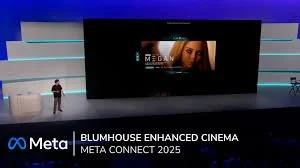
That’s the promise of Enhanced Cinema, a new medium Mark Zuckerberg announced at Meta connect this year, starting with the release of Blumhouses M3GAN & Black Phone.
Learning from 3D (briefly)
We’ve been here before, sort of. I still remember being handed a pair of cardboard glasses with red and blue lenses and watching a massive shark terrifyingly come at me out of the screen. At the time it blew my little teenage mind.
Later came Avatar, which showed 3D at its best, and suddenly every blockbuster was shipping with flimsy plastic specs. For a moment it felt like the future.
At the time it seemed that 3D was here to stay. However, in the end, 3D became a gimmick and those plastic glasses ended up in the bottom of a drawer with all those random cables that you keep ‘just in case’.
The lesson? Format alone doesn’t transform culture. Without artistry and purpose, it’s just (pardon the pun) spectacle.
Beyond the Flat Screen
Enhanced cinema isn’t about replacing the things we already love. It’s about enriching them by breaking films, sports, music, and documentaries out of the flat screen and into layered, spatial, living experiences.
Picture this:
Film. A horror scene where the atmosphere isn’t just seen, it seeps into your space. Fog rolls past your sofa, objects break the frame, and the sound isn’t coming from “left speaker, right speaker” but from behind your ear.
Sport (F1). Reimagine race highlights as multi-angle spectacles. Your feed anchors in space, walls transform into your team’s garage, and at a key overtake extra screens burst up: on-board, helicopter, trackside, even rival POV.
Music. A live gig where the stage pyrotechnics burst beyond the screen, and the bass reverberates through your walls thanks to spatial audio. Fans don’t just watch the show, they’re in the middle of it.
Documentaries. Imagine a natural history series where a school of fish doesn’t just cross the ocean on screen, it swims around you. Or a historical documentary where archival footage expands into a 3D world you can walk through.
This isn’t the “VR escapism” of old. It’s additive, layered, and designed to amplify the mediums we already know. Enhanced cinema doesn’t ask an audience to leave reality; it brings the story into their personal space.
Why This Matters Now
The timing couldn’t be better.
Hardware is here. From VR headsets to AR glasses to spatial audio headphones, the devices capable of delivering enhanced cinema are finally in our hands.
The foundations are in place. From room-mesh visuals to spatial audio, the building blocks that make enhanced cinema feel embodied are already here.
Audiences are ready. Consumers expect more than passive viewing. Interactive, embodied, on-demand experiences are second nature to a generation raised on gaming and TikTok filters.
Archives are vast. Film studios, sports leagues, and music labels sit on decades of content waiting to be remixed, re-experienced, and re-monetised. Enhanced cinema is a way to unlock new value from old stories.
This isn’t about a speculative “maybe in 10 years.” It’s already happening in early projects across cinema, sport, and music. The question is who moves first, how new tools and interfaces can help scale this new medium and who defines the playbook.
Astral City’s POV
At Astral City, we’ve been fascinated by this space for a long time. We believe enhanced cinema isn’t a gimmick or an experiment. It’s a format revolution in the same way widescreen or streaming once were.
And revolutions need architects.
Studios, leagues, brands, and artists need partners who can help them test, validate, and launch enhanced experiences without losing sight of the story or the audience.
That’s one of the reasons why we are actively engaging with this emerging format, building on our experience across XR, AI and spatial computing, and looking ahead to how enhanced media will reshape culture.
The Next Great Format
When 3D arrived, it dazzled but didn’t endure. Enhanced cinema has the chance to be the next natural step in how we experience entertainment and culture.
Stories don’t want to stay flat. Songs don’t want to be trapped in two speakers. Sports moments don’t want to be replayed from just one angle. The future is layered, spatial, and alive.
Enhanced cinema is where film, sport, music, and documentaries go next. And once audiences experience it, they won’t look back.